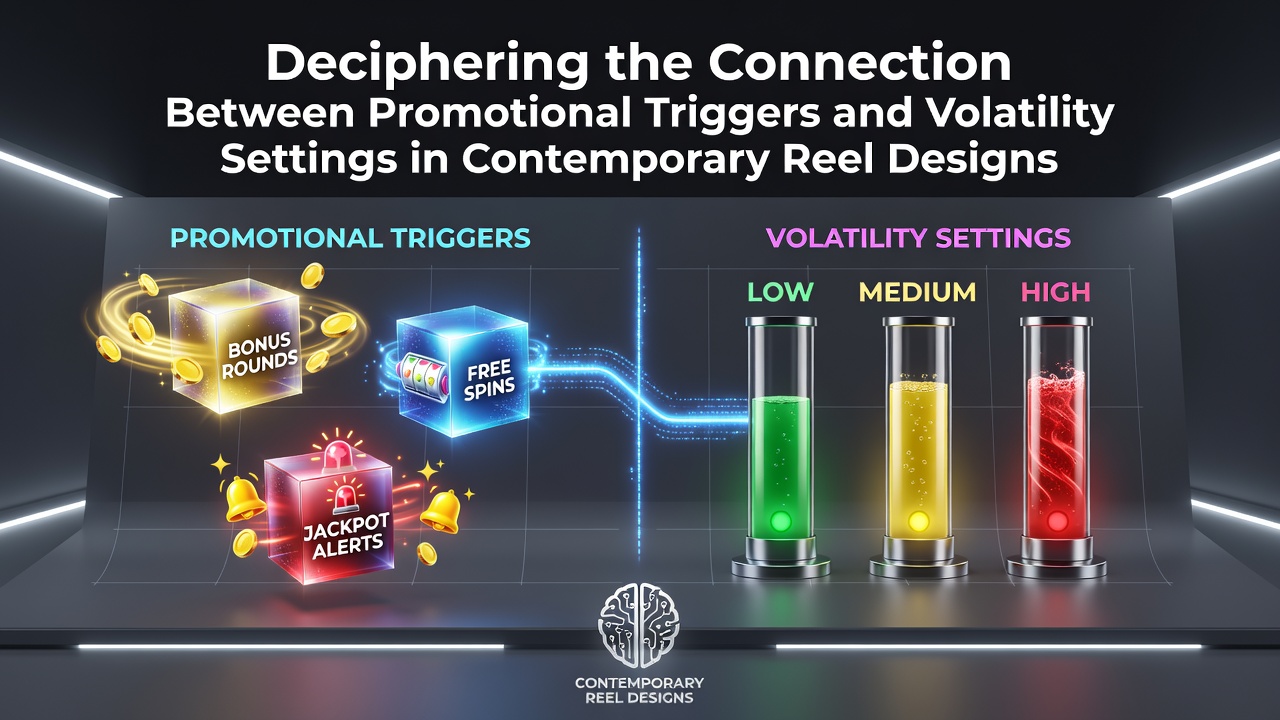
Deciphering the Connection Between Promotional Triggers and Volatility Settings in Contemporary Reel Designs
Contemporary reel designs integrate promotional triggers such as bonus round activations and free spin sequences directly into the mathematical framework that determines volatility levels. Game developers calibrate these elements so that trigger frequency aligns with the intended payout distribution patterns across thousands of spins. Observers note that high-volatility configurations often position triggers behind longer symbol combination chains while low-volatility setups embed them within more frequent smaller alignments. Design teams establish volatility through the distribution of reel symbols, payline structures, and the weighting of special trigger symbols. Promotional triggers function as conditional events that modify return-to-player calculations during active bonus phases. Researchers have mapped how the probability of entering these phases influences overall game variance, creating measurable differences between titles that appear similar on the surface.Core Mechanics Linking Triggers to Volatility
Reel strips contain designated positions where promotional symbols land and initiate feature modes, and the spacing of these positions directly affects hit rates. When designers increase the gap between trigger symbols on physical or virtual reels, they raise volatility because players encounter bonus rounds less often yet receive larger average rewards when features activate. Conversely, tighter symbol clustering lowers volatility by generating more regular but modest payouts during triggered sequences.
Engineers adjust multiplier values and additional reel expansions inside bonus modes to fine-tune the balance. Data from testing laboratories shows that a single trigger event can shift effective volatility by 15 to 30 percent depending on the duration and multiplier depth of the feature. These adjustments occur before regulatory submission, ensuring compliance with jurisdictional standards on randomness adn fairness.
Design Evolution Through 2026
By July 2026 multiple manufacturers had adopted dynamic reel mapping software that recalibrates volatility parameters based on real-time promotional trigger performance across player cohorts. This software tracks symbol distribution outcomes and modifies future reel weights during scheduled maintenance windows without altering certified random number generator outputs. Industry reports document that such systems maintain consistent house-edge margins while allowing operators to rotate promotional intensity across different market segments.
Take one development studio that introduced layered trigger hierarchies in its flagship series; each hierarchy tier carried distinct volatility signatures that activated sequentially. Players encountered base triggers more frequently under low-volatility settings, whereas higher tiers reserved rarer activations for elevated variance profiles. Testing data confirmed that this tiered approach produced smoother bankroll trajectories compared with earlier static designs.

Regional Regulatory Influences on Trigger-Volatility Calibration
Regulatory bodies outside the United Kingdom have issued updated guidelines that require transparent disclosure of how promotional triggers interact with volatility metrics. The Nevada Gaming Control Board maintains technical standards that mandate simulation reports showing trigger frequency distributions across minimum and maximum bet levels. Nevada Gaming Control Board technical standards specify that any change to trigger weighting must undergo re-certification when volatility shifts exceed predefined thresholds.
Similar requirements appear in documentation from the Australian Communications and Media Authority, where operators must submit volatility curves tied to each promotional feature. These curves illustrate expected payout ranges during triggered sequences versus base game play, allowing oversight agencies to verify that advertised return percentages remain accurate after bonus activation.
Testing Protocols and Data Verification
Independent laboratories run millions of simulated spins to verify that promotional trigger rates match declared volatility classifications. Engineers compare actual hit frequencies against theoretical models, adjusting reel strip compositions when deviations exceed tolerance limits. One documented protocol involves isolating each trigger event and measuring its contribution to overall standard deviation before approving the title for distribution.
Additional verification occurs through live-environment monitoring after release. Operators collect anonymized session data that reveals whether trigger occurrences align with pre-launch projections under varying stake sizes. Discrepancies prompt reel redesigns that restore intended variance without modifying certified random number generator algorithms.
Conclusion
Contemporary reel design processes treat promotional triggers as integral components of volatility architecture rather than separate add-ons. Calibration begins during initial symbol placement and continues through iterative testing that accounts for regulatory reporting requirements across multiple jurisdictions. Evidence from certification records and post-release analytics demonstrates that precise alignment between trigger probability and volatility settings produces consistent mathematical outcomes while satisfying oversight standards. Ongoing software refinements observed through mid-2026 indicate that developers continue refining these relationships to maintain compliance and operational predictability.